 Skip to main content.
Blog
Open Telco AI at MWC26 Doha – creating AI that ‘speaks telco’
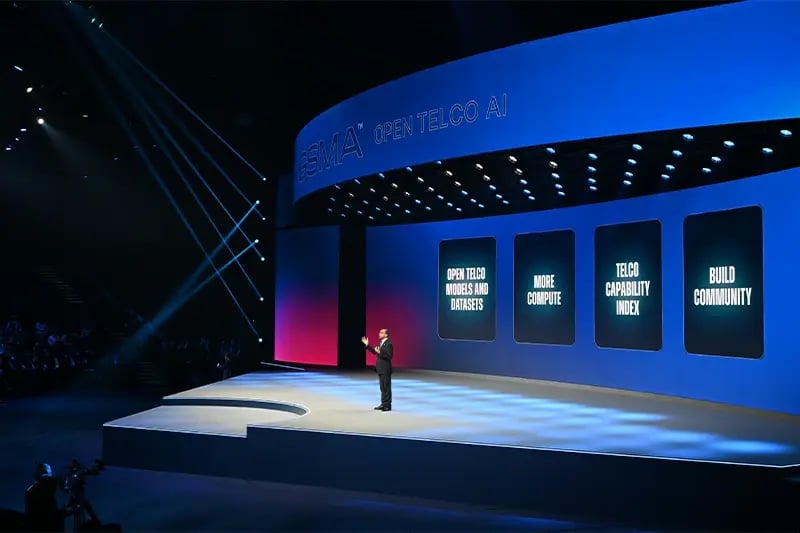
Since its launch in Barcelona in March 2026, Open Telco AI has brought operators, vendors and researchers together to build AI that understands networks. At MWC26 Doha, a dedicated summit will ask practical questions, including what telco-grade AI is worth to operators.
Telecoms needs its own AI
Frontier AI models can now write complex code and pass professional exams. But ask one to interpret a 3GPP specification or diagnose a radio network fault and its accuracy falls away. These models learn from public data and network knowledge is rarely public. In this industry and in this space, there aren’t any equivalents for the droves of hired professionals that have taught AI how to write, to interpret and to calculate.
Operators spend around 34% of their operating costs on network operations, yet GSMAi data shows that only around 16% of AI investment made by telco businesses has reportedly gone to this area of development.
GSMA benchmarking work with AT&T has shown that small models fine-tuned on telecoms problems could outperform much larger general-purpose models on specific tasks, and at a lower cost. Open Telco AI puts that approach within reach of the whole industry. AI is not yet fluent in ‘speaking telco’, but that’s a hurdle the GSMA aims to overcome.
A well-founded initiative
GSMA Director-General Vivek Badrinath introduced Open Telco AI in his opening keynote at MWC26 Barcelona in March this year. AT&T and AMD were founding supporters, and the online platform launched at open-telco.ai.
The initiative rests on five open building blocks. These are:
- LLM benchmarks and the Telco Capability Index
- Open models
- Open data
- Accessible compute
- The contributor community
The last building block – community – has attracted more than 46 organisations and contributors in over 35 countries.
AT&T released around 30 telco models at launch. Six months later, that number had climbed to around 40 models supporting tasks such as network configuration and fault analysis. Some of these models have reached 93% accuracy or higher. As is the nature of leaderboards, positions have changed as models improve and vie for pole position. Khalifa University’s TelecomGPT-R1 led in June, before AT&T’s OTel 2.0, built on Google’s Gemma 4, pulled ahead to first place in July – and is still holding lead position.
Pre-register for the Doha Open Telco AI summit to get prioritised access.
Tools for operators and vendors
Since the first benchmarks went live in February 2025, the Open Telco AI Leaderboard has become a highly dynamic, industry-standard, shared reference point. It scores specific datasets, such as 3GPP specifications, and combines the results into an overall ranking – measuring how models such as Gemini, Anthropic or Llama perform against curated telco benchmarks.
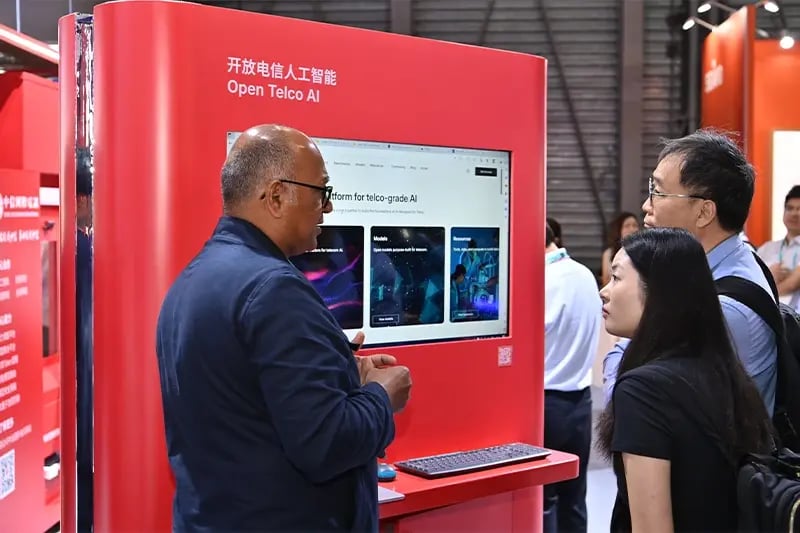
Operators can use the leaderboard to choose models for specific needs. Vendors can use it to identify how their models compare and compete across the range of datasets.
Some notable mentions in 2026 include:
- Huawei, Headline Sponsor of MWC26 Doha, created TeleLogs, an open dataset used to train root-cause analysis models.
- The Telco Common Corpus (TCC) has been developed by Pleias.ai and the GSMA, providing over 10 billion tokens of fully open, freely available telecommunications knowledge (scientific literature, patents, open data and open-web projects).
- AT&T’s OTel 2.0 was built using 400 billion tokens and is the largest telecoms-specific model ever released.
- A large telco model has been built on NVIDIA Nemotron.
- AMD and TensorWave GPU capacity for training and fine-tuning.
Creating measurable value
The next phase of development moves to quantify the value of the Open Telco AI platform. The central question for the Doha summit is how telco-grade AI can deliver measurable efficiency, lower operating costs and commercial benefits.
Two priorities lead this work: firstly, establishing how much more training and data would be required for deeper specialisms; and secondly, documenting real-world use cases and return on investment.
Autonomy is one performance indicator and is judged via the TM Forum scale, in which Level 5 means a fully autonomous, self-healing network. Today’s capabilities range from recommending fixes with a human in the loop to partially autonomous healing – some organisations self-measure at around a 4 or 4.5 on the scale. A planned agentic evaluation suite, called the NOC benchmark, will also test whether AI agents in a network hallucinate, take inappropriate actions or produce detectable anomalies.
As telco AI performance indicators mature, the leaderboard will move towards more granular categories, so contributors can show where their models excel and measure value more accurately. These include the use of LLMs to understand complexity, implement solutions, conduct root-cause analysis and other engineering specifics.
The world of fully autonomous networks is still some way off, but within sight. The models being developed as part of the Open Telco AI initiative aim to augment and simplify relatively mundane tasks, allowing engineers to focus more on urgent or strategic activities.
Inside the Open Telco AI Summit, 10 November
Experts on the MWC26 Doha stage will walk the summit audience through the five open building blocks, as well as the agentic AI, capability-building and partnership programmes that are built on them.
The summit brings together some of the brightest thinkers in connectivity technology, and is designed for:
- Founding-partner operators
- Operator-based senior AI and machine-learning practitioners
- Heads of network AI
- Autonomous-network architects
- Silicon and network vendors
- Researchers
- Academic centres
This year’s participants include Veon Group, Ooredoo Qatar, Red Hat, Google, Huawei, NetoAI and Khalifa University. Deloitte is the Gold Summit Sponsor.
Pre-register for the summit to get prioritised access and ensure your place.

Models and skills to meet the challenge
Aside from telco and operator collaboration at an organisational level, the GSMA has already succeeded in accelerating innovation using hackathon-style challenges. In one of these challenges – based on root-cause-analysis – Stanford University students improved models to as much as 99% accuracy. These hackathons allow telco model owners to benefit from a community of contributors working collectively to improve capability, rather than relying solely on in-house teams.
The AI Telco Troubleshooting Challenge launched at MWC Doha in November 2025 and ran for two months, during which 1,255 participants from 104 countries submitted 3,545 models across three challenge tracks. In July this year, the Agentic AI Challenge kicked off, with 1,408 participants signing on, and 354 submitting solutions across two competition tracks.
The GSMA is now building on the momentum with four contests planned across the annual MWC Series. The next challenge, to be announced in Doha this November, is the TelcoRetrieve Challenge.
Telecom engineers can't trust generic LLMs: issues such as hallucinated citations and missing context are a continuing liability. TelcoRetrieve provides an open, vendor-neutral RAG pipeline, grounding LLMs directly in the standards.
The goal of the challenge is to improve that grounding further. Participants will work on the retrieval layer and fine-tune the models used in the pipeline. Improvements will be evaluated on two leaderboards: a public leaderboard for testing and iteration, and a private leaderboard used for the final ranking.
Get involved
The launch of the challenge will be announced at the Open Telco AI Summit at MWC26 Doha. Participants will be able to enter and monitor their progress on Zindi, the AI challenge platform. Additional updates will also be published on the Open Telco AI website.
The GSMA also has a year-round submission policy for organisations and individuals to submit general or specialist models to the Open Telco leaderboard for evaluation and recognition. Get in touch if you would like to contribute or arrange benchmarking of a model.