 Skip to main content.
Blog
Augmented Intelligence: A Better Life for All
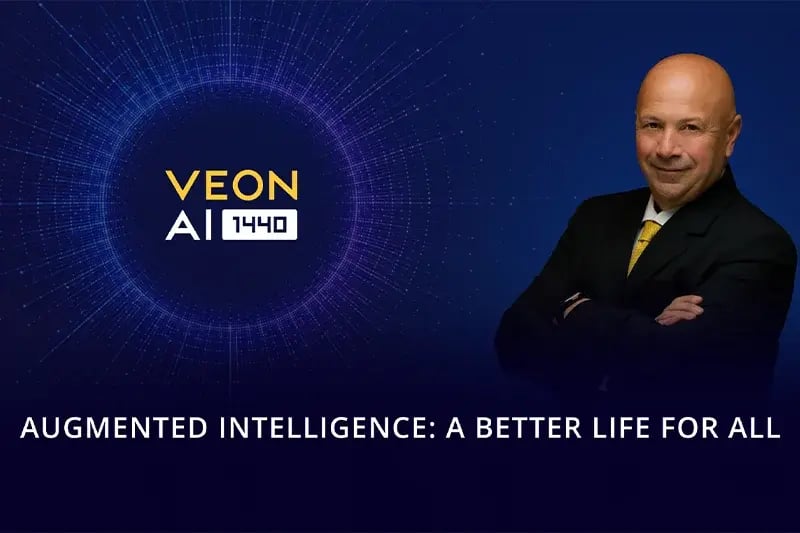
By Kaan Terzioğlu, Group Chief Executive Officer, VEON Group and Chair of the GSMA Foundation Board
From connecting people to expanding human potential
A year ago, we sat down and asked ourselves a simple question: what is VEON actually for. The answer we came back to was a better life for all, delivered not in the big moments, but in the ordinary ones: the 1,440 minutes that make up a customer's day. We call that commitment DO1440.
A couple of months back in New York, a friend introduced me to a Bangladeshi investor, mentioning us as the group that owns Banglalink. He didn't know the brand, until I mentioned Toffee, our entertainment platform, and his face changed. That's DO1440 in practice: customers increasingly know us through what our services let them do, not just through a phone call. Over the last three years, we've invested roughly USD 2.4 billion across our markets, in the networks that connect people and the digital platforms built on top of them.
Augmented intelligence is the next chapter of that same commitment: connectivity got people access, DO1440 made that access useful every day, and now AI1440 is what happens when that daily use gets smarter, helping people learn faster, decide better, and earn more, in those same 1,440 minutes.
I spend a lot of time in rooms where AI is discussed as a race between a handful of model builders. We connect more than 150 million people across five markets through mobile networks and reach over 227 million people through digital services. That's convinced me that a different question matters more for most of the world: who puts that intelligence in front of a person, in a language they speak, connected to something they can actually use. For us, AI means augmented intelligence: expanding people's ability to learn, make decisions, and earn a living.
That belief rests on three things we're building at once: sovereign local-language models, services that help people achieve more in their daily lives, and agentic AI that helps the businesses and communities we serve. Here's what each looks like in practice.
Intelligence That Understands You
None of this works if the intelligence doesn't literally speak the customer's language. So, since 2023 we've been building local-language models market by market, rather than licensing someone else's.
Kaz-LLM, developed with QazCode, our Kazakhstan-based AI company, and the country's Institute of Smart Systems and Artificial Intelligence, coordinated with the Ministry of Digital Development, was built on more than 150 billion tokens collected, synthesized and translated into Kazakh, Turkish, Russian and English, and launched in December 2024. It now supports roughly a million customer journeys a month in a market where global model builders have limited reach, and in 2025 it earned the GSMA Foundry Excellence Award, external recognition that sovereign AI built for one market can meet a global bar.
In Ukraine, Kyivstar has partnered with the Ministry of Digital Transformation on a Ukrainian LLM built on Google's Gemma, now in its active phase, intended as the foundation for AI-powered services across both public and private sectors.
QazCode has also signed an agreement with MeetKai, a sovereign AI company, to roll out similar local-language models across our wider footprint, and in Pakistan, JazzWorld has an ongoing partnership with the National University of Sciences and Technology, the Ministry of IT & Telecom, and the National IT Board to build the country's first local LLM, trained on Urdu, with datasets already being built for Pashto and Punjabi.
This matters for a reason that goes beyond language alone. In markets like Bangladesh and Pakistan, for most people the phone in their hand isn't one way to reach the internet; it's the only way. For most of that customer base, a model built without their language or their context offers little they can actually use. Digital operators bring something distinctive to this work: local relationships, distribution, and market understanding built over decades, worth more when combined with technology partners, universities and governments than built alone.
Intelligence That Helps You Achieve More
The second layer is what customers actually feel. Our financial hero advisor tool, built into JazzCash, our Pakistani fintech with over 27 million active users, is a clear example. It uses alternative digital data, wallet transactions and payment patterns among them, to assess creditworthiness for people outside the formal banking system, and to help them decide what they can safely borrow and when. That's a genuine shift for Pakistan's unbanked population, who can access real-time credit through pre-whitelisted limits, preapproved borrowing amounts determined from signals like mobile usage and transaction history rather than a credit file most of them have never had the chance to build. Within the same market, the AI agent inside Simosa, our SIM-care and lifestyle platform with over 33 million users, already serves more than a million people every month.
In Ukraine, Helsi, which offers AI-assisted booking, lab-result interpretation and telemedicine consultations, reached 5 million active users during the last quarter, many in places where the nearest clinic is a genuine journey rather than a short walk.
And in education, the Janymda app with over 6 million active users in Kazakhstan applies the same idea, using AI to support students whose nearest qualified tutor may be a city away.
Intelligence That Helps Businesses and Communities Thrive
The third layer is probably less visible to consumers but just as important to how fast the first two can scale: agentic AI built for the clients of our enterprise businesses. QazCode in Kazakhstan, Kyivstar.Tech in Ukraine, Teknosys and Garaj in Pakistan, bCloud in Bangladesh, and BuildX, Beelab and VEON AdTech in Uzbekistan serve corporate and government clients directly across AI, cloud and data businesses.
We tested this philosophy on ourselves first. KaanAI, an interactive avatar built from my own voice and thinking, is already available to our 19,000 employees across every market, answering questions about strategy, financial results and the reasoning behind our biggest calls. We plan to open the same conversation to the public next.
Bridging the AI Divide, Together
GSMA's own State of Mobile Internet Connectivity report, released this month, warns of an emerging global AI divide: more than 3.4 billion people still don't use mobile internet, even though most of them already live within reach of mobile broadband. AI for Impact, GSMA's initiative bringing operators together to use AI for social good, points in the right direction. But the industry needs to go further than good intentions. 83 percent of the world's population lives outside the OECD's 38 member countries. For most of that population, digital operators bring something no one else quite has: the network, local-language capability built market by market, and the daily trust to put intelligence somewhere it can actually be used.
AI1440 is our answer to a simple test: does intelligence show up for people in the 1,440 minutes that make up their day, in a language they speak, on a device they already carry? For the more than 150 million people we connect and the over 227 million we reach through digital services, we intend it to, and we'd like more partners in technology, government and research to help us take it further. Build local-language intelligence with us. Embed it in the services people already rely on. Help us measure whether it's making lives better.
We'll make that case at MWC26 Doha this November, where the 2026 theme, "The IQ Era," is built around the same idea: going further together, human and AI, public and private, nation and neighbours. Augmented intelligence, done right, is that same togetherness in practice: not intelligence replacing people, but intelligence and people going further, together, toward a better life for all.
- The author is Group CEO of VEON and a member of the Board of Directors of the GSMA. He can be reached on X at @Kaan_Terzioglu