 Skip to main content.
Blog
Seven views of future networks in MENA
MENA is a vast region with a mobile technology sector that will contribute around $400 billion to its collective GDP by the end of 2026. According to GSMA Intelligence data, mobile penetration rate in MENA will rise towards 77% of the population by 2030, when subscribers are forecast to reach 555 million.
But within this region, no two markets run on the same rulebook – spectrum, licensing and data compliance differ across borders. National timelines and priorities vary too, as shown by these seven snapshots of 5G and 6G from around the region – meaning cross-border expansion has its challenges, but also opportunities.
The GCC
Seven years on from commercial launch, and following heavy investment in 5G, priorities across the GCC have pivoted from coverage to practical application. Legacy networks are being retired to free up spectrum across member nations, and the reality of 6G is no longer a distant promise. Several recent 6G announcements, including one from the SAMENA Telecommunication Council Leader’s Summit in Dubai this April, reveal the ambition of the region.
GCC nations are among the world’s leaders in advanced revenue-generating capabilities, including Standalone architecture, 5G-Advanced, uplink performance and network slicing. Ookla and Omdia benchmarking recently put the GCC's 5G Standalone download speed at nearly five times that of Europe and the fastest of any region worldwide. And this year, the UAE and Qatar featured at the top of Kearney’s Global Telecom Health Index, outperforming the most successful markets around the world.
Qatar
Qatar's operators are pushing the boundaries of 5G Standalone into services that explore more than speed alone, enabling network slicing for industrial and private customers and expanding use cases for edge computing. Data centre capacity and real-world 6G testing are keeping pace, supporting AI and IoT adoption across healthcare, transport, government and utilities as the country works toward its 2030 digital transformation goals.
- Qatar’s national 6G Testbed Platform was launched by the Communications Regulatory Authority during MWC25 Doha.
- Ooredoo recently announced the selection of Oracle Alloy to deliver real-time data processing through the sovereign AI and cloud platform, with applications in sectors such as smart healthcare aligned with Vision 2030 ambitions.
- In April 2026, Ooredoo launched a new low-power, wide-area Long Term Evolution for Machines (LTE-M) network to support IoT applications ranging from smart city management to industrial automation.
Bahrain
An industry-first this year in Bahrain has coincided with a boost in global rankings. Zain Bahrain, working with Ericsson, became the first operator in the region (and one of the first anywhere outside a handful of US trials) to run an AI-native scheduler live on a commercial 5G radio network, redistributing capacity and cutting energy use in real time.
- The kingdom climbed three places to reach sixth place in the ITU's 2026 ICT Development Index, scoring 98%.
- Bahrain also ranked second regionally on the World Bank Group’s GovTech Maturity Index and fifth globally on the Digital Citizen Engagement Index.
- Ericsson is supplying Zain Bahrain with new Massive MIMO and low-band radio hardware to boost 5G network capacity nationwide, supporting Bahrain Economic Vision 2030 and the road to 6G.
Oman
Oman's operators have been closing the coverage gap in line with Oman Vision 2040. Omantel reached 92% 5G population coverage in 2024 on the back of sustained capex growth, while Ooredoo Oman lifted 5G coverage from 79% to 97% in just 12 months.
- Last year, the Telecommunications Regulatory Authority (TRA) upgraded more than 5,600 sites to free up spectrum for 4G and 5G.
- The TRA also recently announced a preliminary study on 6G networks to support national readiness.
- Opensignal's 2026 Global Mobile Network Experience Awards named Vodafone and Ooredoo Oman global leaders for Upload Speed Experience, in a ranking group with Finland, Japan and Türkiye.
At MWC26 Doha the Future Networks Summit brings together the people building the GCC’s next generation of infrastructure: network architects in step with policy regulators; tower and infrastructure investors who understand the spectrum roadmap; satellite operators talking to hyperscalers.
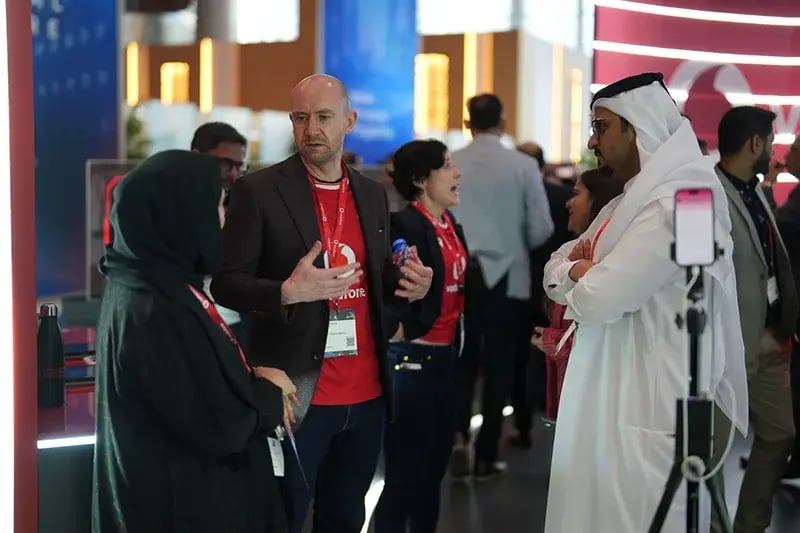
All this is co-located with ITU PP-26, the highest policy-making body of the UN’s agency for digital technologies, where global telecoms and spectrum strategy is decided to 2030. If your business builds on or supplies 5G capability, and aims to be ready on the starting blocks when 6G springs to life, you need to be at MWC26.
Wider MENA
Ericsson's June 2026 Mobility Report counts 750 million mobile subscriptions across MENA, with 5G subscribers up 33% year-on-year to 80 million – even with penetration at just 11%. Nations in the wider MENA market are covering ground according to their transformation priorities, from same-year commercial launches to sovereign-backed 5G projects.
Egypt
This August, Egypt’s National Telecommunications Regulatory Authority (NTRA), Telecom Egypt and Huawei made history with a trial of mobile services in the upper 6GHz band, in a first for both the country and Africa. And earlier this year, the Telecommunication Regulatory Authority signed a £2.6 bn agreement with four mobile network operators to boost 5G expansion, in a move that roughly doubles spectrum use.
Türkiye
In Türkiye, a spectrum auction that raised £2.2 bn went to live commercial 5G in under six months. Turkcell secured a £739 m Murabaha loan in March of this year to fund its 5G and next-generation network build-out – the largest syndicated Islamic financing facility ever raised by a Turkish company. Turkcell, Türk Telekom and Vodafone Turkey then activated services simultaneously across all 81 provinces in April, with an ambitious goal of full nationwide coverage by April 2028.
Algeria
Algeria launched 5G commercially in December 2025 after awarding licences worth £363 m to Mobilis, Djezzy and Ooredoo, with a six-year national plan targeting full coverage. Operators are already ahead of schedule: Ooredoo Algérie reached all 58 provinces by March 2026, exceeding its first-year target, while Djezzy expanded from its initial 8 to 18 provinces in the same window. Algeria’s National Digital Transformation Strategy aims to boost the digital sector’s GDP contribution to 20% by 2030.
Iraq
Iraq's network story is currently defined by surging consumer mobile data usage and enterprise demand for bandwidth, cloud connectivity and industrial IoT networks – fuelling a £2.2 bn telecoms market that is forecast to keep growing steadily to 2031. Earlier this year, Zain Iraq announced an expansion of predictive AI across its network operations, and Asiacell publicised the planned opening of a 5G lab at Al-Nahrain University's College of Information Engineering, sponsored by the Communications and Media Commission. A statement from the Iraqi government last month pointed to a strategy for simultaneous rollout of 5G across the country.
Your global hub for essential future network insights
Seven snapshots from seven different markets – all with their own priorities, plans and regulation. Successful navigation of future network development in the GCC and across MENA depends on getting a complete view, and on managing the differing requirements for compliance and approvals throughout the region.
MWC Doha gathers a wide circle of specialisms for collaboration and dialogue – from 6G researchers to tower companies, and from spectrum regulators to investors funding the next decade of build-out. The range of expertise at MWC Doha gives visitors the full circle of planning, building, activation and scale for 5G and 6G networks – and not just a single slice.

Who should come to the MWC26 Doha Future Networks Summit
- Network architects and CTOs looking at the realities of switching from 5G-Advanced to 6G-ready infrastructure
- Hyperscalers, GPU vendors and sovereign cloud providers providing AI-ready compute
- TowerCos and infrastructure investors assessing next-generation site and connectivity models
- Satellite and non-terrestrial network operators extending coverage beyond ground infrastructure
- Enterprise and Industry 4.0 leaders deploying private networks and network slicing
- Developers and platform providers building on network APIs and Open Gateway
- Regulators and policy makers shaping spectrum, licensing and localisation frameworks