 Skip to main content.
Blog
Six views of smart mobility in MENA
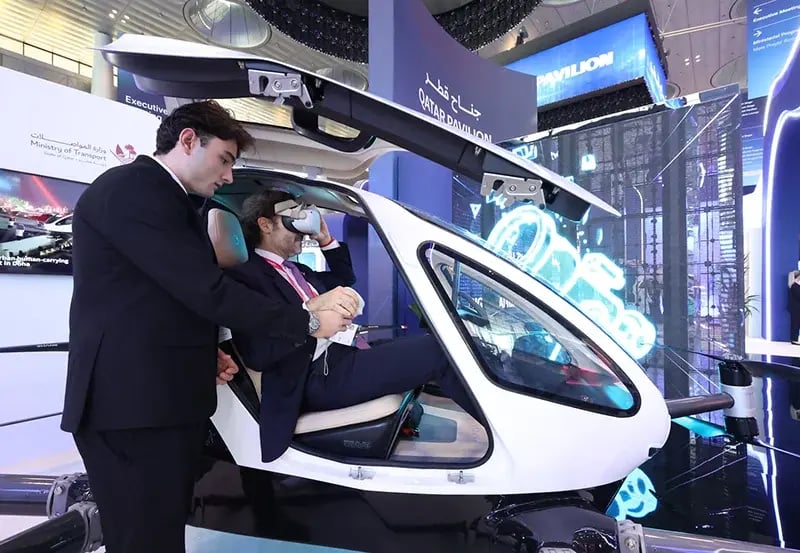
“The GCC stands at a pivotal inflection point in the evolution of mobility.” – PwC
The GCC, included in the wider Middle East and North Africa region, is an area of around 65 million people, with a combined sovereign wealth fund of as much as £4.5 trillion. It's well suited to smart mobility initiatives thanks to widespread connectivity, some of the world’s fastest 5G speeds, broad streets, one-way systems and flat geography. GCC nations are investing heavily in capability to support national and regional initiatives, driving intelligent transport and electrified networks through public-private partnerships. According to PwC, the GCC's fully autonomous vehicle market will reach £14 bn by 2035.
Qatar
Qatar has electrified almost three-quarters of its public bus fleet and is aiming for 100% in line with National Vision 2030. Autonomous airport vehicle trials are complete and trials with level 4 robotaxis (meaning no human involvement) closed out with a 94% success rate. Electric and autonomous vehicle assembly operations in the Qatar Free Zones Authority serve a regional market that reaches more than 2 bn people. Doha hosts its second Autonomous e-Mobility Forum in September, enabling conversations that will flow naturally into MWC26 Doha’s dedicated Smart Mobility Summit in November.
- Around £1.2 bn is committed to TASMU – Qatar’s smart technology programme and digital marketplace that matches outside vendors to live use cases.
- Qatar Science and Technology Park launched a £22 m fund in May this year, investing in deep tech in sectors that include smart infrastructure, aviation technology and mobility.
- Qatar could reach up to £740 m in autonomous mobility value by 2035 (PwC).

The UAE
Uber and WeRide run fully driverless robotaxis in Abu Dhabi – the first time Uber has offered the service outside the US – and have committed to at least 1,200 robotaxis across Abu Dhabi, Dubai and Riyadh by 2027. A freight truck pilot at Khalifa Economic Zones is in early-stage readiness testing. e&'s Carrier & Wholesale Services unit has partnered with Lenovo Connect to expand connected vehicle and IoT services across multiple markets.
- Dubai is targeting 25% of all transport journeys to be driverless by 2030.
- KEZAD's automotive sector is actively recruiting Tier 1 suppliers under Abu Dhabi's industrial incentive programme.
- Mobility Live Middle East took place 9-10 June 2026 at Dubai World Trade Centre.
Saudi Arabia
Saudi Arabia is approaching smart mobility with a focus on scale and manufacturing; hosting the 2034 World Cup is a major planning milestone. Public robotaxi rides began in Riyadh late last year, with a small fleet running under supervised conditions. In manufacturing, a partnership between Lucid and Nvidia is aimed at building level 4 autonomous EVs for a homegrown supply chain.
- 15% of public transport autonomous by 2030.
- Tasaru Mobility Investments aims to bring global expertise into the local electric vehicle (EV) and autonomous vehicle (AV) supply chain.
- The Transport General Authority’s AV Regulatory Sandbox is the open licensing route for new operators; WeRide was first through the gate in 2025.

At MWC Doha the Smart Mobility Summit brings together all the people who visualise and deliver national initiatives. Analysts who are in step with policy executives; edge developers who understand the spectrum landscape; planners ready to speak to builders. The whole ecosystem – from software to satellites – turns talk into street-level reality.
Wider MENA
"Looking at the vertical sectors in MENA, the automotive and mobility sector shows the most optimistic expectation for ROI from digital transformation spend." – GSMAi
The GCC is no investment island: significant developments of high-performance infrastructure are underway across the region. GSMAi analysis shows that the automotive and mobility sector ranks first for 5G importance, first for the highest expectations of 5G IoT use case opportunity and first for the highest awareness of API network benefits. Automotive and mobility is also the second most active industry sector for current use/future importance of technologies enabling digital transformation.
Egypt
The East of Nile Monorail, the first in Africa, began commercial service in May 2026 – a major milestone in Egypt’s journey to Vision 2030. The driverless service has the capacity to carry up to 45,000 passengers an hour in each direction, reducing both congestion and commuter times – it’s estimated that some journeys can be cut from around 80 minutes by road to about 40 minutes by monorail. Egypt is the largest recipient of foreign direct investment in North Africa, followed by Morocco.
Morocco
While conventional transport upgrades take place across the country, Casablanca, Rabat, Marrakech and Tangier are installing sensors and cameras to manage traffic in real time using AI, with the 2030 World Cup providing a national deadline.
A large-scale national plan, including over 50 free trade agreements, aims to position Morocco as a regional EV manufacturing hub. This includes Africa’s first industrial zone dedicated to EV battery production, the Jorf Industrial Accelerator Zone. Another key business zone, Tangier Automotive City, already hosts EV producers Renault and Stellantis; newer entrants include Tesla's Kenitra assembly plant and Neo Motors' locally designed, EU-certified Dial-E.
Tunisia
Tunisia is also reaching for the title of manufacturing powerhouse for the region. The country is already Africa's second-largest producer and exporter of automotive parts, with the sector supporting around 300 businesses and 120,000 jobs, and creating £3.3 bn in exports a year (around 37% of this goes to Germany). A planned 300-hectare Smart Automotive City could add up to 150,000 more jobs, as well as new partnerships. The initiative aims to secure industrial assets, capitalise on a highly skilled workforce, and fully integrate into global automotive engineering and design value chains.
- The government is seeking roughly around £222 m in new investment for EV and smart vehicle manufacturing.
- A strong emphasis on electric mobility aiming for 125,000 electric cars and 12,000 public charging stations by 2035.
Your global hub for smart mobility insights
Six governments progressing at six different speeds, working towards six different visions of smart mobility – just some examples of the market opportunities as roadmaps shift to rollouts across the region.
The most reliable way for CTOs who want to know what’s really happening in the market, and where the real opportunities lie, is to get the word on the street at the region’s forum for connectivity leaders. The conversation at MWC Doha isn't limited to a handful of specialisms. It includes 6G planners, IoT designers, satellite operators, edge infrastructure providers and custodians of the connectivity infrastructure that is foundational to smart mobility across the board.
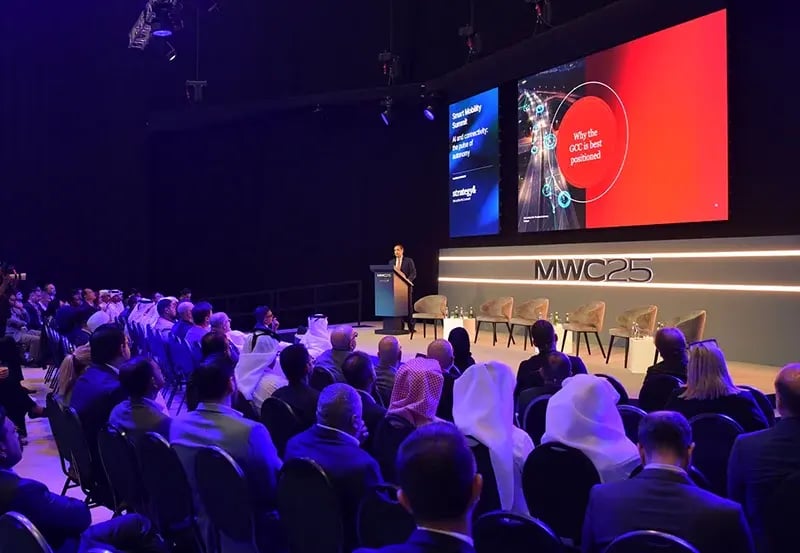
Bringing that full range of expertise together in one place, at the same time, means that buyers walking the floor can understand the full context of planning, building, delivery and scale.
Who should come to the MWC26 Doha Smart Mobility Summit
- Robotaxi and AV platform providers weighing up which governments need support and who is closest to a commercial licence
- Transport authorities and public operators comparing notes on scaling, rollouts, successes and challenges
- Automotive component and Tier 1 suppliers looking for connectivity partners for their next generation of vehicles
- Telecoms operators, chipmakers and sensor manufacturers delivering 5G, 5GA, edge and satellite infrastructure
- Traffic-management software developers and AI data smart city integrators