 Skip to main content.
Blog
Mobile Economy Middle East and North Africa 2026
Every year, the industry turns to the GSMA’s annual publications to gauge regional mobile technology markets and understand where changes are occurring.
The Mobile Economy Middle East and North Africa 2026 report from GSMA Intelligence is your window into the latest economic, user and network trends. The compiled data and in-depth analysis cover the connectivity landscape of the last year and revise forecasts until 2030, a milestone year for national visions in the region.
The report will be made available just prior to the opening keynote at MWC26 Doha, which will reference key statistics and analysis. Join us at MWC26 and get the full benefits of data-led conversations in person – from roundtables and leadership forums to senior-level networking.
Get insights like these only from the GSMA.
Mobile is becoming a bigger contributor to MENA's economy
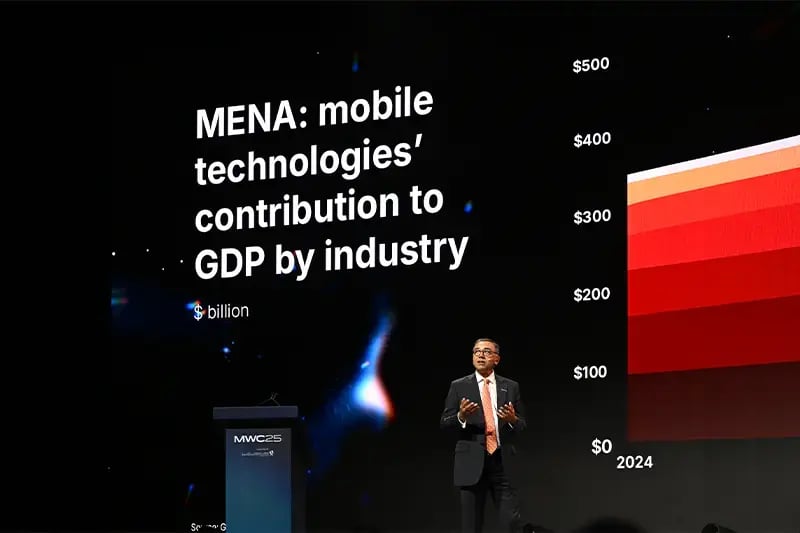
Mobile’s economic contribution is forecast to grow at a CAGR of 4.4% between 2025 and 2030, compared with 3.7% for regional GDP. The full report, released on 8 November, details the big numbers relating to economic value and GDP share of mobile technologies and services in MENA. It also analyses mobile economy growth rates and forecasts in relation to the wider regional economy.

Mobile's impact extends well beyond the telecoms sector
Mobile’s largest economic impact increasingly extends beyond the telecoms sector, enabling productivity gains and digital transformation across manufacturing, services, finance, construction and public services. The report provides detailed statistics relating to the direct contribution of the mobile ecosystem to regional productivity. For example, manufacturing and services are projected to account for almost half of the benefits of mobile, while construction and real estate are expected to account for 15% by 2030 and agriculture for 9%. For MWC26 Doha, this shifts the narrative from the size of the mobile industry to the value it creates across the wider economy.
5G adoption is accelerating, led by the GCC
Each year, the Mobile Economy MENA report collates data to highlight the regional pace of technology transition. For example, in the GCC 5G adoption reached 49% in 2025 and is forecast to rise to 95% by 2030, compared with a global average of 57%. This year’s report also notes an expanding regional footprint, with Morocco, Algeria and Libya launching 5G between November 2025 and January 2026, followed by Türkiye’s three operators in April 2026.
The industry is entering another major investment cycle
This growth will require continued investment. MENA operators are forecast to spend $88.9 billion in capex between 2025 and 2030 as they expand 5G and prepare for the next phase of network evolution. As well as providing a deeper look at operator revenue forecasts, the report identifies FWA, enterprise services, IoT and satellite integration as important monetisation opportunities.
AI is creating a new infrastructure opportunity for the region
AI is emerging as a major new dimension of MENA’s digital economy, particularly in the Gulf. The region is building AI infrastructure at global scale, creating opportunities for operators to connect, host and commercialise AI services as sovereign compute capacity expands. The planned UAE–US AI Campus in Abu Dhabi is designed to provide 5 GW of AI data-centre capacity, beginning with the 1 GW Stargate UAE cluster. Saudi Arabia’s HUMAIN targets 1.9 GW of data-centre capacity by 2030 and 6.6 GW by 2034. According to the report, Microsoft plans to invest $15.2 billion in the UAE between 2023 and 2029, including more than $4.6 billion already spent on AI and cloud data centres, while AWS is investing more than $5.3 billion in a Saudi cloud region. Operators bring relevant assets to this opportunity, including data centres, fibre networks and licensed local operations.
Mobile already supports millions of jobs and substantial public revenues
Alongside its GDP contribution, mobile has a significant employment and fiscal footprint. Approximate numbers of direct and indirect jobs supported by the mobile ecosystem are detailed in this year’s report. The sector also generated $40 billion in public revenue through taxation.
Bring your regional knowledge of the mobile ecosystem up to date with GSMA Intelligence and statistics you can trust.
Benchmark against the 2025 report.
Read the full report here from 8 November.