 Skip to main content.
Blog
Report out now: 5G monetisation in MENA

GSMA Intelligence is relied on by leading operators, vendors, regulators, financial institutions and third-party industry players, to support strategic decision-making and long-term investment planning. The data is used as an industry reference point and is frequently cited by the media and by the industry itself.
The GSMAi team of analysts and experts produce regular thought-leading research reports across a range of industry topics. And for Doha this year, that means three feature reports: the annual Mobile Economy MENA 2026 report, and two special reports for 2026, Enterprise Digital (available for subscribers only) and a special analysis of 5G and monetisation.
Here are some key findings from this year's in-depth review of the 5G landscape in MENA – read the full report and get the most out of conversations at MWC26 Doha in person from 8-10 November. In particular, take the opportunity to explore regional 5G leadership at the dedicated GSMA Future Networks Summit.
MENA's 5G story is shifting from deployment to monetisation
MENA has made substantial progress in deploying 5G, but the strategic focus is shifting from network rollout and subscriber migration to generating sustainable returns on investment. By September 2026, 17 of MENA’s 24 markets had launched commercial 5G, while connections are forecast to rise from 67 million in 2025 to nearly 350 million by 2030. Operators are expected to invest a further $53 billion between 2026 and 2030 as networks migrate towards 5G SA and 5G-Advanced, infrastructure is upgraded and reliance on 4G declines.
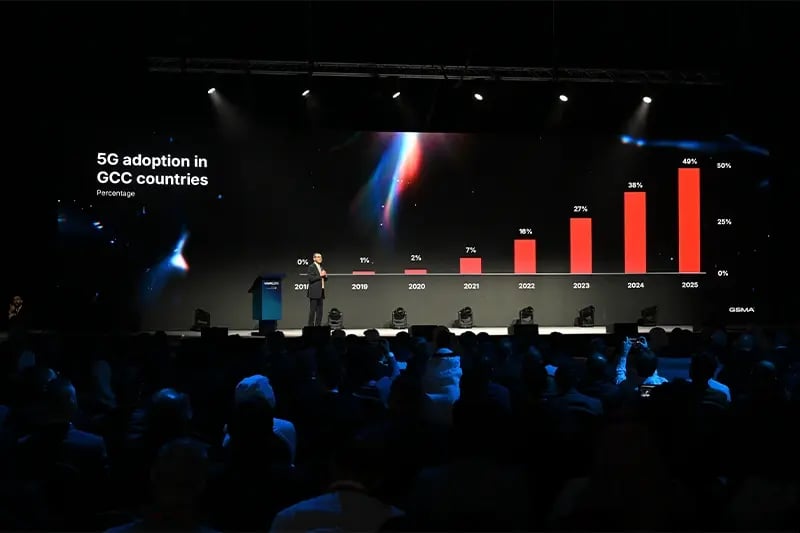
The GCC has some of the strongest foundations for 5G monetisation
The opportunity is not uniform across MENA. GCC markets have the region’s strongest foundations for monetisation, combining extensive coverage and high adoption with growing 5G SA deployment and national digital-transformation programmes. Kuwait, the UAE and Qatar ranked first, second and third, respectively, among 46 countries in the 2026 GSMA 5G Connectivity Index. Average 5G adoption across the GCC is forecast to reach 95% by 2030, compared with 56% globally. As of September 2026, MENA’s commercial 5G SA deployments remained concentrated in the GCC, with 11 operators offering services across all six markets.
Fixed wireless access is currently the clearest consumer monetisation opportunity
Among consumer propositions, fixed wireless access (FWA) provides the clearest evidence of sustainable 5G-related revenue generation in MENA. Rather than asking mobile users to pay a modest premium for 5G, FWA enables operators to address the much larger household and SME broadband market. By November 2026, 36 of MENA’s 56 commercial 5G networks, or 64%, included an FWA offer. Fixed wireless accounts for approximately one fifth of broadband connections in Saudi Arabia.
Private 5G demonstrates how connectivity can become an industrial platform
Private 5G is beginning to turn connectivity into industrial infrastructure across MENA, with deployments spanning energy, manufacturing, ports and public services. The report highlights several examples. In Morocco, inwi, China Mobile International and Huawei announced the country’s first private industrial 5G network in April 2026 at a 52-hectare factory in the Nador West Med industrial hub. ADNOC and e& are developing a private 5G network spanning 11,000 sq. km of onshore and offshore operations, connecting sensors embedded in more than 12,000 wells and pipelines. Operators in the GCC are also applying 5G, network slicing and edge infrastructure to use cases including port automation, utilities, manufacturing and secure communications.

5G monetisation increasingly intersects with AI
Operators can combine network, fibre, data-centre and edge assets with AI infrastructure to pursue opportunities such as GPU-as-a-service, sovereign AI platforms and edge AI. GCC examples include e& UAE and Core42’s sovereign AI compute service, while stc’s data-centre subsidiary, center3, agreed in December 2025 to form a joint venture with HUMAIN, targeting up to 1 GW of capacity. However, much of the value from AI infrastructure could accrue to state-backed AI companies and hyperscalers. The greater 5G-enabled opportunity for operators lies in delivering edge AI to enterprise locations through private networks and network slices.
Take these insights further in person at the region's most influential event for connected technologies. Talk 5G and monetisation opportunities with data-led confidence from GSMA Intelligence.
Read the full report here from 8 November.